
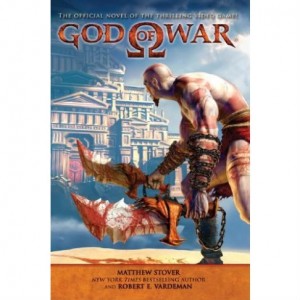
Front cover
The novelization of Sony’s flagship series was released by Del Rey Books on May 25, 2010 written by New York Times bestselling author Matthew Stover and Robert E. Verdeman. Matthew Stover is perhaps best known for his four Star Wars novels, including the novelization of Star Wars III: Revenge of the Sith. He has also written several fantasy novels, including Iron Dawn and Jericho Moon. He has written three science-fiction/fantasy hybrid stories featuring a hero named Caine: Heroes Die, Blade of Tyshalle, and Caine Black Knife. Robert E. Vardeman’s fantasy series include the War of Powers, Cenotaph Road, The Swords of Raemllyn, The Jade Demons, The Keys to Paradise trilogy, The Demon Crown trilogy, and a British-published trilogy called “The Accursed.” Their collaboration on the God of War novel truly brought the game into new light.
The novel follows Kratos’s adventure through the ancient Greek world in search of Pandora’s Box, the one tool that can kill a god. Ares, the God of War, lays waste to Athens, the city of his sister the Goddess of Wisdom Athena. Her city being crushed by Ares fury, Athena seeks help from Kratos to save her city since Zeus has declared the gods not to wage war of one another. The novel gives a look behind the curtain as to why the gods aided Kratos. Athena’s deceitfulness is amplified and her story alone adds to the experience like played in the game. I like how she is made to be able to manipulate her godly relatives, including her father Zeus, into aiding Kratos unaware of her goal. The gods in the novel closely resemble how they are in actual mythology. They’re conniving, deceitful, and distrustful of each other, treating human life like a commodity. I gained new insight about the game through Stover and Vardeman’s depiction of the Greek gods and Kratos. Even my own fascination with mythology was peaked while reading this book. Granted, it was when I played the game but now it was even more so.
The God of War novel not only covers everything from the game but it also adds a little more depth and understanding to the story and to why certain characters aid the Ghost of Sparta. All the gods’ stories, including Athena’s deceitful nature, adds to the original experience that you’re likely to have had with the game. Above all, Kratos and the God of War name were treated with the respect and understanding they deserved, staying true to the game while seasoning it with a little more flavor.
This book certainly helped answer the “hows” and “whys” of the game. I recommend it to any gamer who enjoyed the game as much as I have and/or are curious to see what happens beyond the game. The God of War novel sheds new light on a truly awesome game.

