
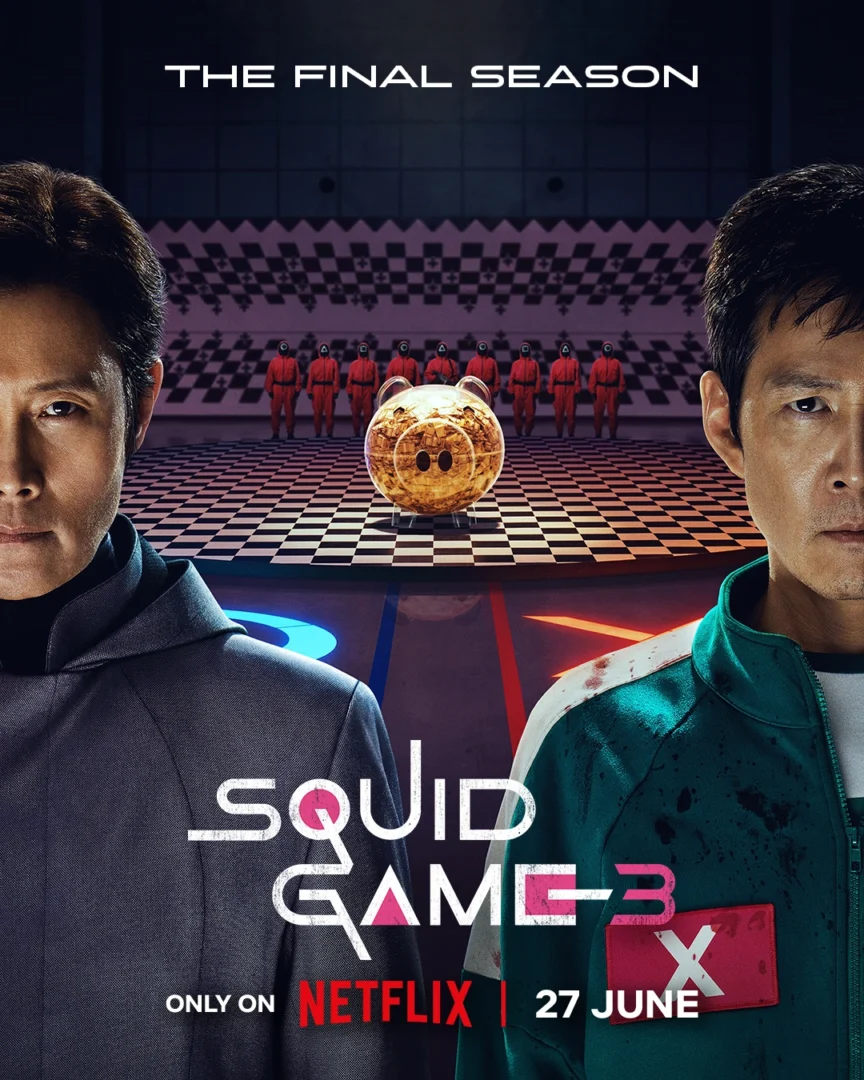
LET THE FINAL GAMES BEGIN.
Netflix’s South Korean streaming series, Squid Game, has finally reached its conclusion. The life-or-death contest of children’s games is over, and whoever survived has taken home the 45.6 billion won prize money. But who lived and who died? No spoilers for that here—watch the final season to find out.
Light Spoilers Below!

DESPITE THE MAJORITY OF THE PLAYERS DYING IN HORRIBLE WAYS, I STAND BY MY BELIEF THAT THE CONTESTANTS ON SQUID GAME WERE TREATED MORE HUMANELY THAN THE CONTESTANTS ON TOTAL DRAMA.
Season 2 ended with Seong Gi-hun, Player 456 (Lee Jung-jae), leading a rebellion to overthrow and stop the games, hoping to save the remaining players. The rebellion failed, costing several players their lives. Now, with only 60 players left, the games resume, and the only way to escape is to survive long enough to make it to the final trial.
Throughout Season 3, Gi-hun wrestles with the guilt of his failed rebellion, seeming resigned to his fate. However, a glimmer of hope emerges in Kim Jun-hee, Player 222 (Jo Yu-ri), a pregnant woman expecting her first child. Protecting Player 222 gradually gives Gi-hun a renewed sense of purpose, beyond his desire to reunite with his daughter if he makes it out of the games alive.
Opposing Gi-hun is Hwang In-ho, The Front Man (Lee Byung-hun), a former winner of the games and the man in charge. The season explores their psychological battle as The Front Man tests Gi-hun’s faith in humanity, showcasing their many similarities and differences, with In-ho testing Gi-hun in the same ways that he was tested. Will Gi-hun hold onto what remains of his moral compass, or will he succumb to the darkness and potentially become the new Front Man?
Familiar Tension, Heartbreaking Outcomes
The final six episodes are as tense and anxiety-inducing as ever. Each deadly twist on classic children’s games results in more players meeting gruesome ends. The dwindling player count only amplifies the stakes, as every brush with danger could mark the end for a beloved or hated character. Expect plenty of heartbreak along the way. While the formula remains largely familiar and lacks some of the novelty of the first season, the brutality and emotional weight of the games remain gripping and impactful.
Minor Flaws in the Final Stretch
While Season 3 remains a satisfying watch from episode to episode, it does come with minor flaws. The season feels more like “Season 2.5″ rather than a standalone installment, picking up right after Season 2’s cliffhanger ending. With 13 episodes combined between Seasons 2 and 3—just four more than Season 1—it’s arguable the story could have been streamlined into one season, avoiding the six-month gap between releases.
Additionally, the suspension of disbelief is tested as the few remaining players repeatedly vote to continue the games despite the option to each leave with billions of won (millions of U.S. dollars) so they can pay off their severe debts. While desperation and greed are core themes throughout the series, it becomes increasingly hard to believe that after everything the small handful of surviving players have experienced, the majority of them would choose to keep risking their lives rather than take the money they have.
Subplots That Fall Short
The main storyline remains compelling, but the subplots feel underwhelming. Detective Hwang Jun-ho’s (Wi Ha-joon) search for the island and his brother, The Front Man, plays a smaller role than expected, and his resolution lacks the emotional payoff some fans might have hoped for. By the end, his storyline just feels like an excuse to help pad the episode runtimes out to an hour long.
Conversely, Kang No-eul, Guard 011 (Park Gyu-young), trying to help Park Gyeong-seok, Player 246 (Lee Jin-wook), escape the island to reunite with his sick daughter is more engaging to watch, as it is connected to the games. However, this subplot remains separate from the main story until the very end, with the majority of Guard 011’s actions going almost completely unnoticed by everyone, lessening its overall impact.
The new VIPs are introduced in the final games, and their despicable banter and personalities make them slightly more entertaining than their predecessors from Season 1. But, their dubbed English voices and dialogue feel jarring and cartoonish compared to everything else in the series, and just like with the subplots, the VIPs feel like unnecessary padding that detracts from the central narrative.
A Bittersweet Finale
The series finale is appropriately brutal and bittersweet, if fairly predictable, stirring a mix of emotions that will leave viewers reflecting long after the credits roll. When the remaining players reach the titular squid game in the final round, the tension becomes almost unbearable, increasing with every casuality that is counted. The ending is neither fully happy nor entirely tragic, striking a careful balance that feels true to the series, but may not fully satisfy everyone with how it got there.
A Fitting End to a Phenomenon
Despite some narrative padding and minor missteps, Squid Game Season 3 wraps up the worldwide phenomenon on a poignant and thought-provoking note. The cast remains stellar, with Lee Jung-jae delivering a haunting yet noble performance that cements Seong Gi-hun’s place as one of television’s most memorable protagonists. Another Emmy Award for Jung-jae’s work this season would be well-deserved.
With its scathing commentary on reality shows, wealth inequality, and the extremes people will go to for money, Squid Game will undoubtedly be remembered as one of the most unique, creative, and influential TV shows of the streaming era. While Netflix reportedly plans an English-language adaptation, the original games have officially ended—for now—and it was a wild ride while they lasted.

