
Video games. They take us to a digital world, away from the troubles of real life and allow us to do things that we normally can’t do in reality. We can command armies of Orcs, fight demon hordes and rescue princesses. But did you know that this almost did not come to pass. Yup, years ago, a playing card company saved the home gaming industry so we can kill our friends in cyberspace. This year we celebrate the rebirth of home game consoling by wishing a Happy Birthday to the Nintendo Entertainment System, or the Family Computer for those of you in the Land of the Rising Sun. And taking a look back at the birth of the savior of home game consoles.

The Family Computer (Famicom) released in July 15, 1983
Following the death of disco in the late 1970s and when an actor sat on the throne of Presidency in the early 1980s, the video game market experienced rapid growth due largely to the success of systems such the Atari 2600 and the Intellivision. Third party developers arose in the wake of this boom in gaming to exploit the industry. Nintendo was one such company and, in 1982, found success in arcade gaming with such hits like Donkey Kong, to name one. Nintendo’s R&D team, led by Masayuki Uemura, had been secretly working on a home console system. To keep their invention from breaking the bank, the ideas of a keyboard, modem, and floppy disk were all shot down; however, expensive circuitry was added to provide a versatile 15-pin expansion port connection on the front of the console for future add-on functionality such as peripheral devices. Then on July 15, 1983, Nintendo launched the Family Computer, or the Famicom as it is known by its Japanese-English term, which sold for ¥14, 800 or $148 US dollars. But there was a glitch in the system that forced Nintendo to recall all Famicom units and take a big hit in the change purse. Luckily, the problem was fixed and the systems were reissued with a new motherboard and it went on to outsell its primary competitor, the Sega SG-1000. By the end of 1984, Nintendo had sold over 2.5 million Famicoms in the Japanese market.

Nintendo R&D head Masayuki Uemura
Bolstered by its success in Japan, Nintendo was looking to cash in on the American market. The company entered negotiations with Atari to release their brainchild state side to convince a skeptical public to embrace its system. The system would be released as the “Nintendo Enhanced Video System.” Even though the companies reached an agreement with a contract to sign, Atari pulled out at the last second after seeing Coleco demonstrating a prototype of Donkey Kong for its forthcoming Coleco Adam home computer. Atari looked towards Coleco but the North American video game crash of 1983 put Atari in the red, sending the deal south. After the crash, American retailers dropped the prices on games already on the shelf or stopped them completely. Video gaming soon became considered a fad. Nintendo unveiled its new system, the Nintendo Advanced Video System (AVS) at both the Summer and Winter Consumer Electronics Show (CES) in 1984. But the company’s new toy was met with criticism, particularly towards the keyboard and wireless functionality. Nintendo R&D redesigned the AVS and unveiled the stripped down version at the 1985 Summer CES. Christened the name Nintendo Entertainment System, the NES kept the gray color scheme of the AVS as well as the boxy design. The NES differed from the Famicom with a front loading chamber versus a top-loading slot. Instead of hardwired controllers, the NES controllers featured two custom 7-pin sockets for detachable controllers.
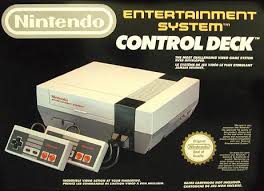
Nintendo Control Deck came with Super Mario Bros and two controllers
The Nintendo Entertainment System debuted on October 18, 1985 just in time for the holiday season with a beta test in the Big Apple. At first, only 100,000 systems were shipped in New York. Impressed with the sales, Nintendo added Los Angeles, Chicago and San Fransico, then 12 other US markets to their list before spreading the NES to the masses nationwide. The NES was available in two different packages: the fully featured “Deluxe Set” which included two controllers, the zapper light gun and Super Mario Bros./Duck Hunt game cartridge, and the “Control Deck” which can with just two controllers and the Super Mario Bros game. Nintendo marketed eighteen launch titles with the wide release. It quickly became the top of children’s Christmas lists and the bane of parents’ wallets. Sears, the largest retailer, sold the NES through its Christmas catalog and Kmart, the second largest retailer, sold it in 700 stores. Nintendo cashed in, having sold 1.1 million consoles, thought the company said they could’ve sold 1.4 million if inventory had held out. In others words, the supply could not meet the demand. They earned $310 million in sales, out of total 1986 video game industry sales of $430 million. The prior year, industry sales topped out at $100 million.
Nintendo had crushed its competitors, Sega Master System and Atari 7800, and remained dominate for the remainder of the 1980s. Unfortunately, the good times didn’t last long. Hudson Soft and NEC, and Sega released the “Turbo Grafx-16” and “Genesis” systems respectively in 1989. Nintendo answered back with the Super NES in 1991 while continuing to support the NES. But demand for the new 16 bit technology quickly rose and NES sales took a nose dive with production of the 8 bit system officially ending in 1995. Still, during its ten year run, 60 million NES units had been sold worldwide.
Today, the NES still remains popular amongst game enthusiasts and nostalgia seekers who are now enjoying the system that made them do their homework and help out around the house as kids. Retro game stores sell refurbished NES units and other game systems of yore as well as the game cartridges. But don’t look forward to paying a severely reduced price. A fully packed “NES Deluxe Deck” in the box can go for nearly $400 easy. And fully packed games still in the box sell still carry the $40-50 dollar price tag they had when they were released and rare or popular titles sell for $60+.
The gaming industry has grown into a juggernaut of development with more companies and indie games pushing to get their titles on the market. Today, the global video game market is valued at $93 billion. And of this wouldn’t have possible if a playing card company hadn’t taken the chance. So thanks Nintendo for giving birth to the NES and giving kids a reason to do their chores and visit grandma more often.
From all of us gamers,
HAPPY 30th BIRTHDAY NES!!
-
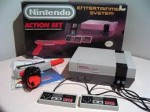
- The NES Action Set came with the zapper light gun, deck, two controllers and Super Mario Bros/Duck Hunt double game cartridge
-
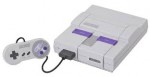
- The Super Nintendo Entertainment System (SNES) released in August 23, 1991
-
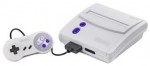
- The slimmer redesigned SNES
-

- Super Family Computer (Super Famicom) released in Japan in November 21, 1990
-

- Nintendo HQ in Kyoto, Japan

How’s this for a flashback?!!

